Other Worlds, Our Climate
By Francis Michael Kuzler — September 2026
This article is based on Francis Michael Kuzler's public presentation at the UCLA Planetarium, September 2026.
On February 14, 1990, the Voyager 1 spacecraft turned its camera back toward home from about 6 billion kilometers away. Earth shows up as less than one pixel, a single speck of light. Astronomers call it the "Pale Blue Dot."
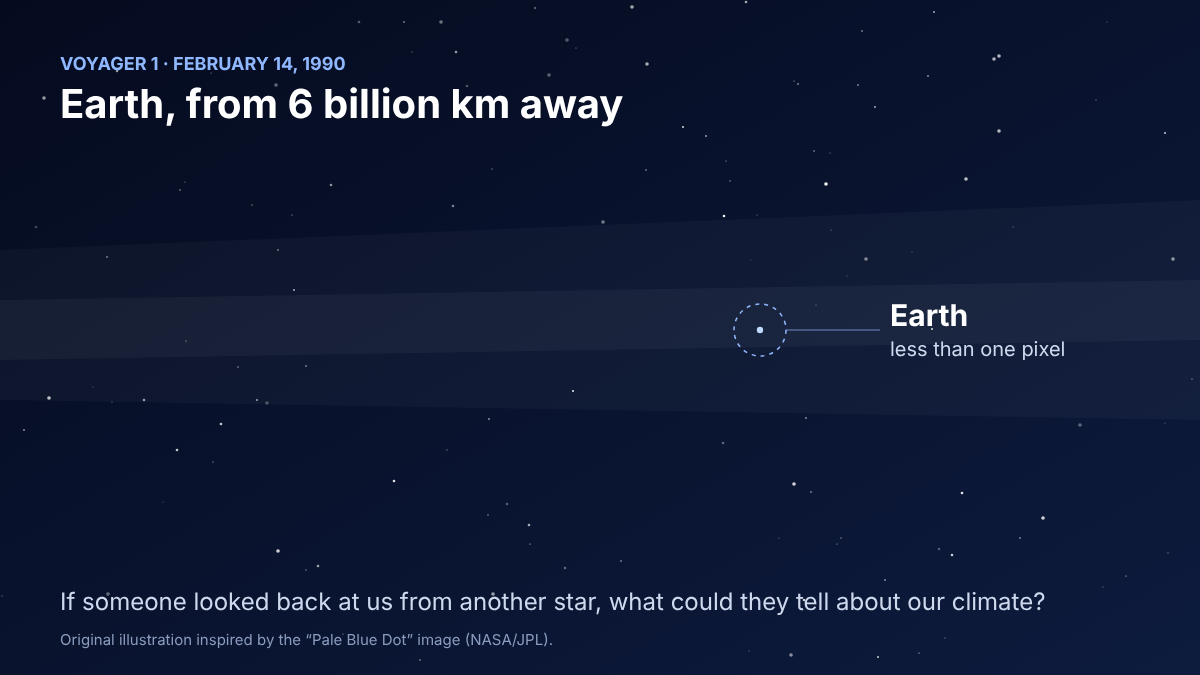
Here is the question I opened my talk with: if someone looked back at us from another star, what could they learn about our climate from that one dot of light? Today, scientists are asking the same question about planets around other stars. Their answers are teaching us something about our own world.
Earth's temperature is a balance
Earth's climate comes down to energy in and energy out. About 340 watts of sunlight per square meter reach the top of our atmosphere on average. Roughly 30% of that is reflected back to space by clouds, ice and bright surfaces. The rest warms the planet, which then radiates heat back out as infrared light.
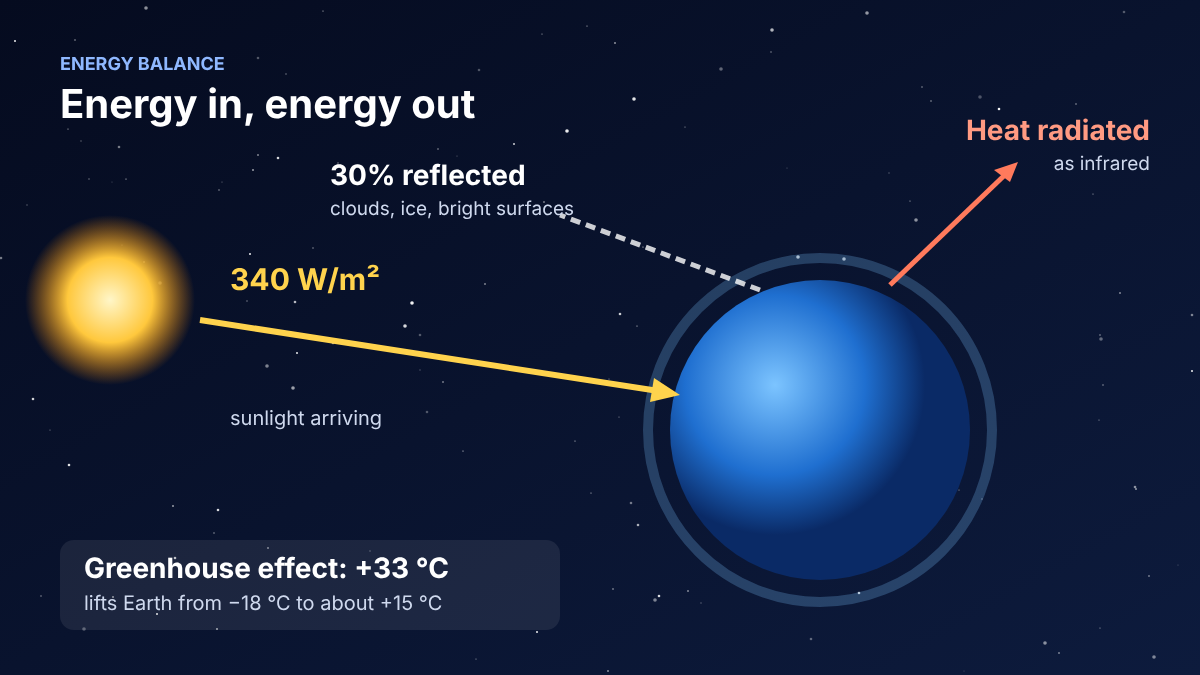
The greenhouse effect is what makes that balance livable. Without it, Earth's average surface temperature would be about −18 °C. With it, we sit near +15 °C, a difference of about 33 °C. Adding more greenhouse gases shifts the balance. That is climate change in one sentence.
Four connected systems keep that balance steady: the greenhouse effect itself, the carbon cycle (rock weathering slowly pulls CO₂ out of the air, a thermostat that works over millions of years), the oceans (which have absorbed over 90% of the extra heat from recent warming), and clouds, which both cool and warm the planet and remain the biggest uncertainty in climate models.
Three planets, one Sun
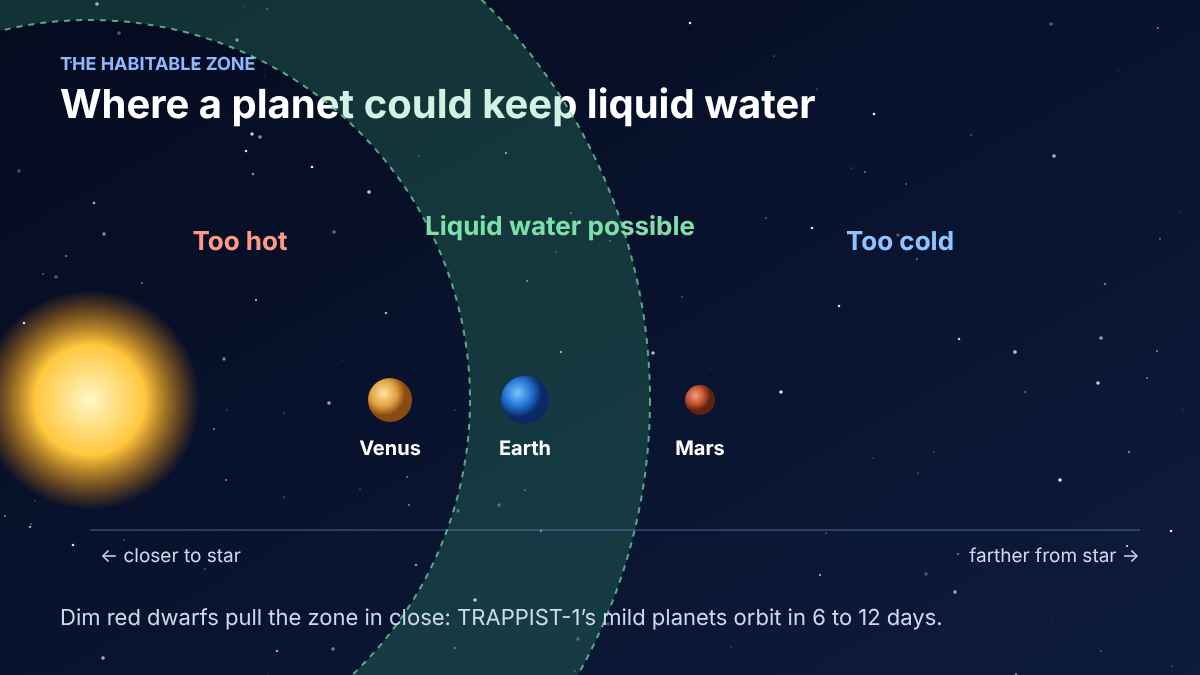
Our neighbors show how differently the same Sun can treat a rocky planet. Venus has a surface temperature around 465 °C and air pressure 92 times Earth's, a runaway greenhouse. Mars averages about −60 °C and lost most of its air. Earth sits between them, with liquid oceans that have lasted billions of years.
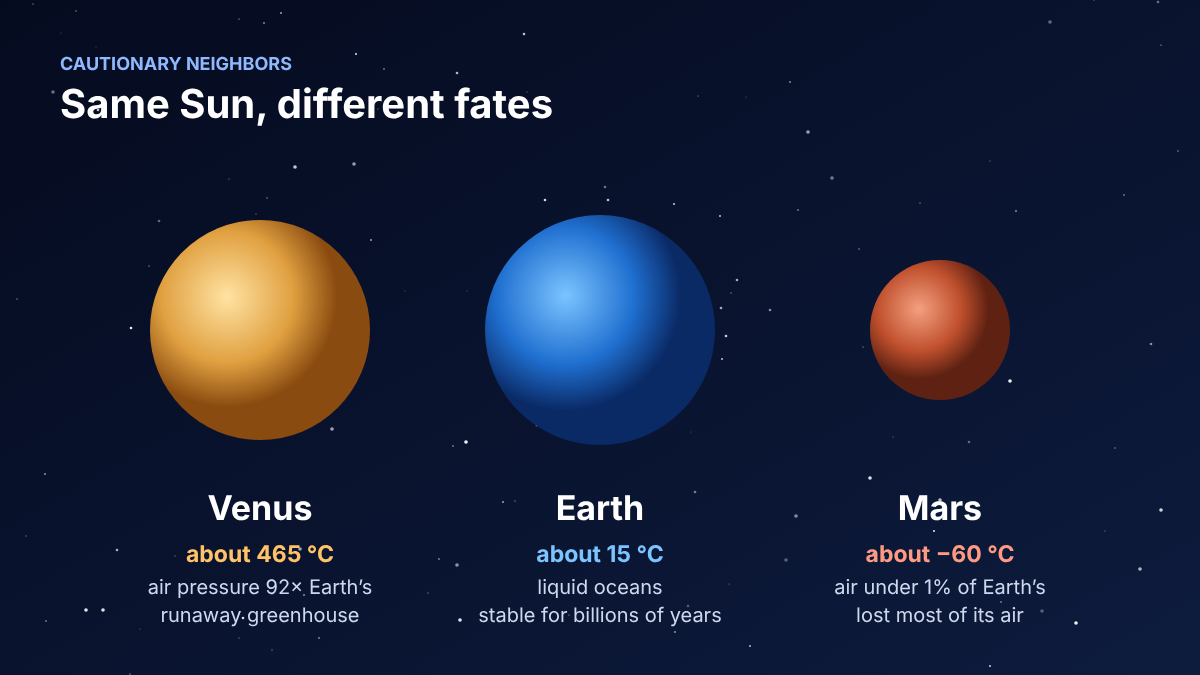
Distance from the Sun does not explain this by itself. Earth and the Moon are the same distance from the Sun, yet Earth averages about 15 °C day and night, while the airless Moon swings from about +120 °C by day to −130 °C at night. Atmosphere and composition matter as much as location.
Finding planets we cannot see
More than 6,000 planets are now known outside our solar system, and most look nothing like Earth. There are "hot Jupiters," gas giants that orbit their stars in a few days. There are super-Earths, a kind of planet our solar system does not have. There is TRAPPIST-1, a star 40 light-years away with seven Earth-sized planets, and Proxima b, the nearest known exoplanet at 4.2 light-years.
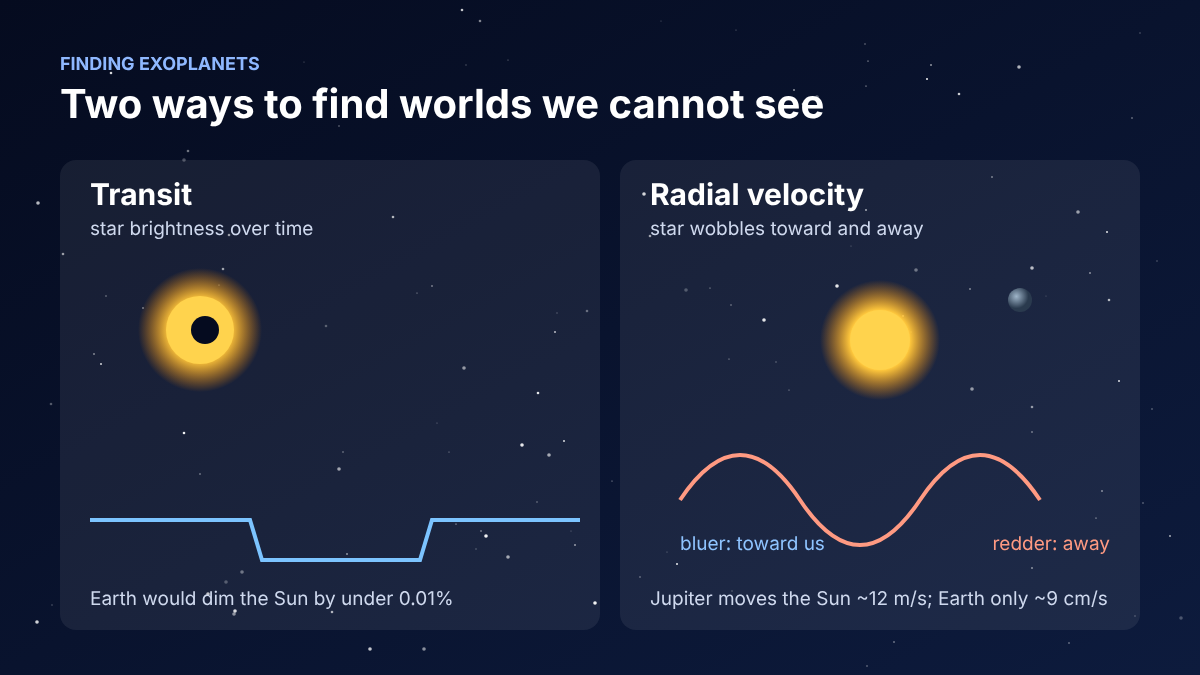
We find most of these worlds without ever seeing them. In the transit method, a planet crossing its star blocks a sliver of light (Earth would dim the Sun by less than 0.01%). In the radial velocity method, a planet's gravity tugs its star back and forth. Jupiter moves the Sun about 12 meters per second; Earth moves it only about 9 centimeters per second. Together, the two methods give a planet's size and mass, and so whether it is rocky or gassy.
Reading the air of another world
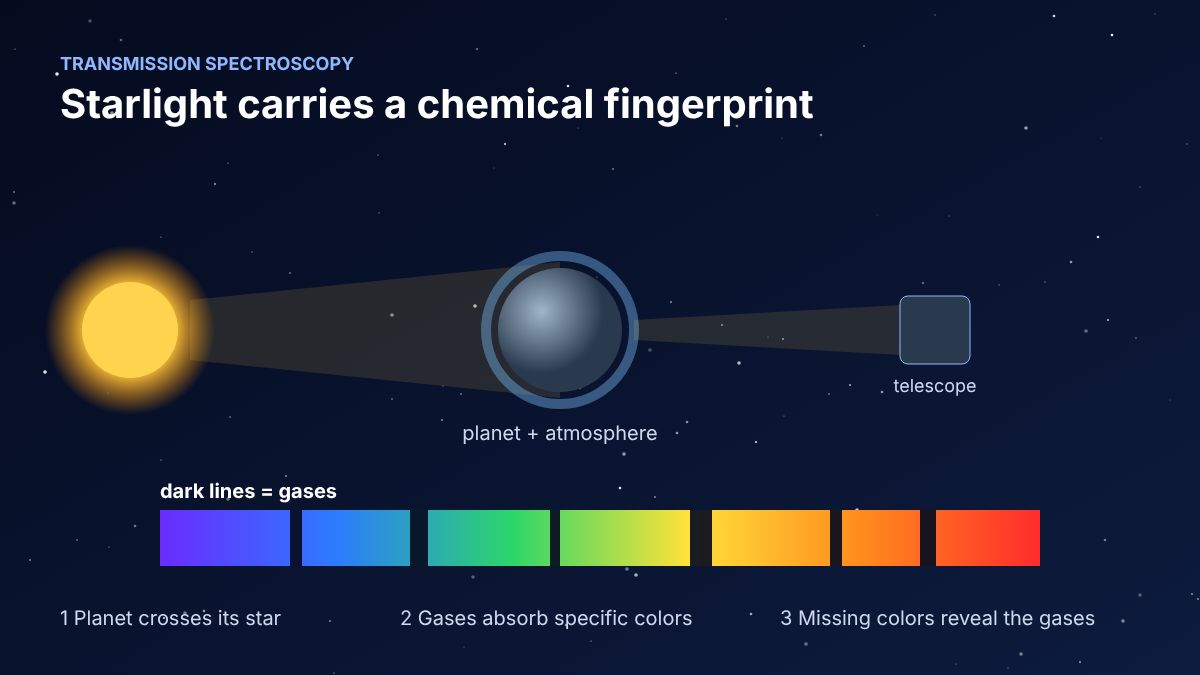
Transits also give us a chance to study atmospheres. When a planet passes in front of its star, starlight filters through a thin ring of the planet's air. Each gas absorbs its own set of colors, so the missing colors in the light reveal which gases are there.
The James Webb Space Telescope is built for exactly this. In 2022 it made the first clear detection of carbon dioxide in an exoplanet atmosphere, on WASP-39 b, and it also measured water vapor on WASP-96 b. Water vapor, carbon dioxide and methane are the same gases that control Earth's greenhouse effect. The physics that detects CO₂ light-years away is the physics of CO₂ warming here at home.
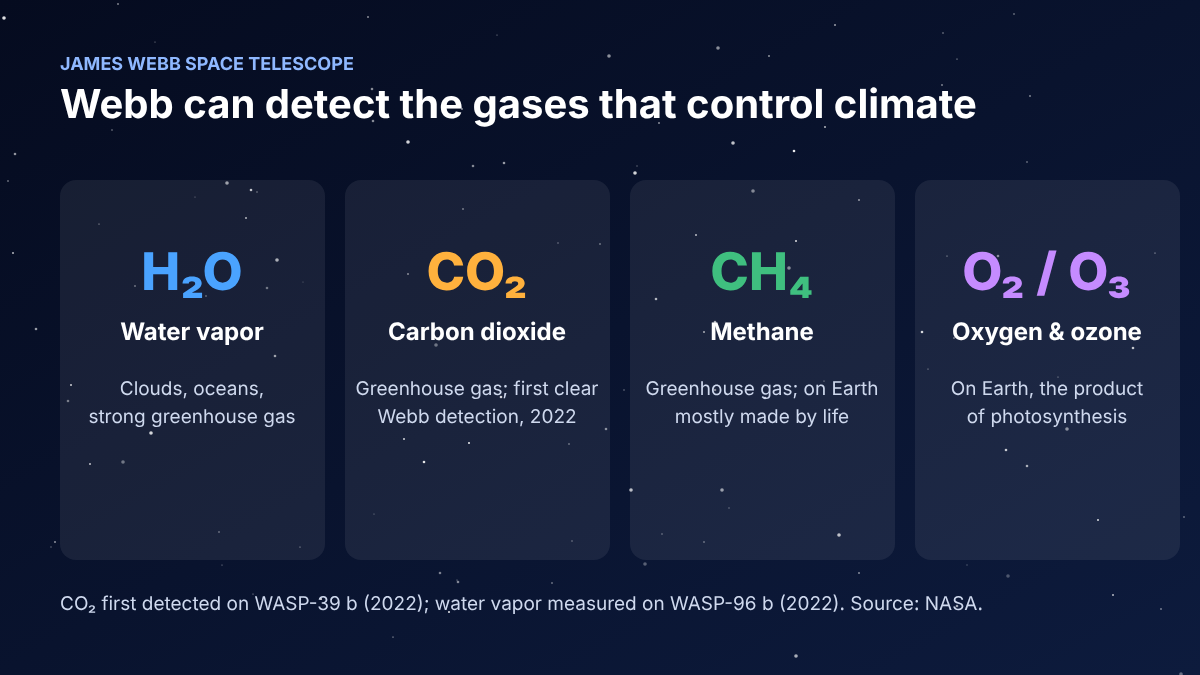
Finding gases is not the same as finding life. Oxygen alone is not proof, since starlight can split water vapor and release oxygen with no life involved. Oxygen and methane together are more interesting, because those gases destroy each other. Keeping both in the air needs a constant supply, which on Earth comes from life. Even then, scientists must consider the star, the planet's history and a climate model of what non-living processes could produce. Recent claims of possible biosignature gases on K2-18 b show how carefully such signals have to be tested.
Climate models go interstellar
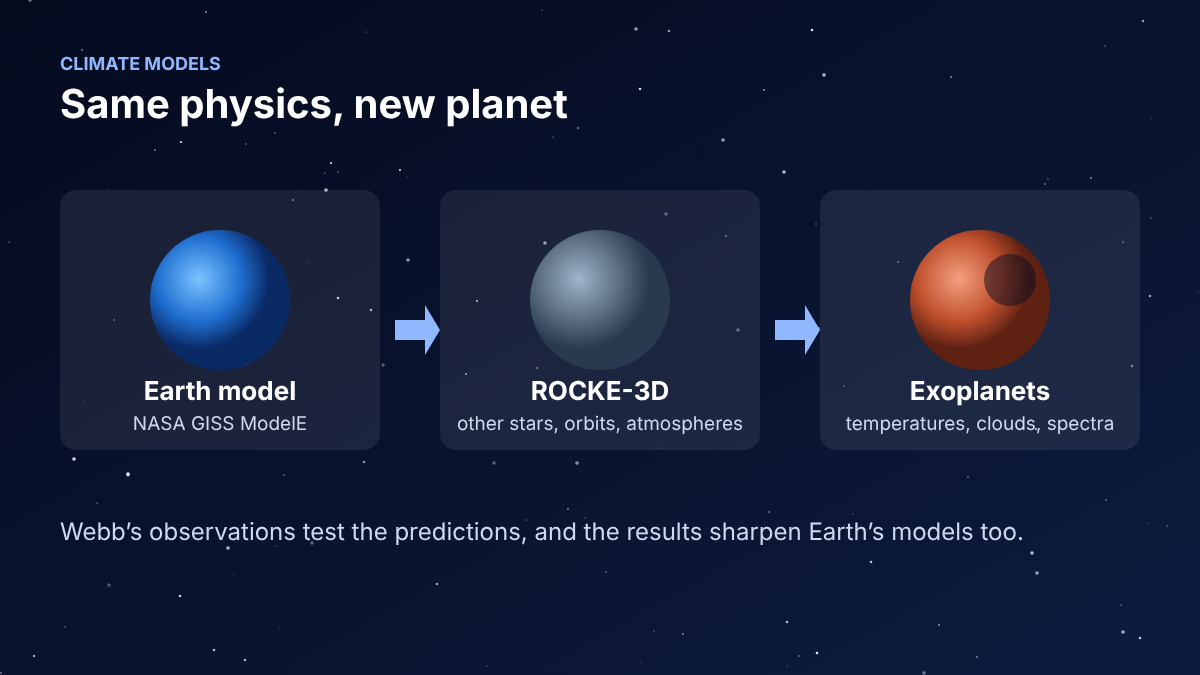
This is where the two fields meet. NASA's GISS ModelE simulates winds, oceans, clouds and sea ice for Earth. A version of the same physics, called ROCKE-3D, has been adapted for other stars, orbits and atmospheres. Swap in a different star, rotation rate and atmosphere, and the model predicts temperatures, clouds and spectra that Webb can then test. The U.K. Met Office's weather and climate model has also simulated Proxima b.
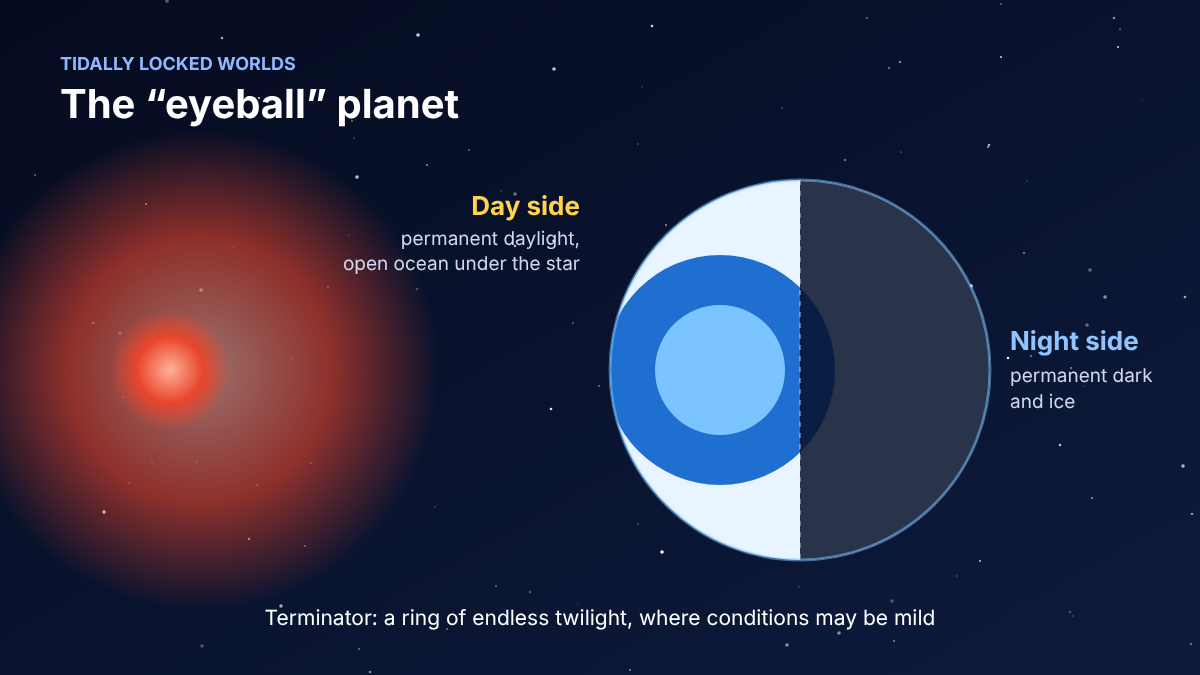
Some of the results are strange. Planets close to red dwarf stars may be tidally locked, keeping one face toward the star forever, as the Moon does with Earth. Models suggest such a planet could have an open ocean on its permanent day side (the "eyeball" planet), ice on its dark night side, and a ring of endless twilight between them where conditions might be mild. Only 3D climate models can tell us whether winds and oceans carry enough heat around to keep a world like that habitable.
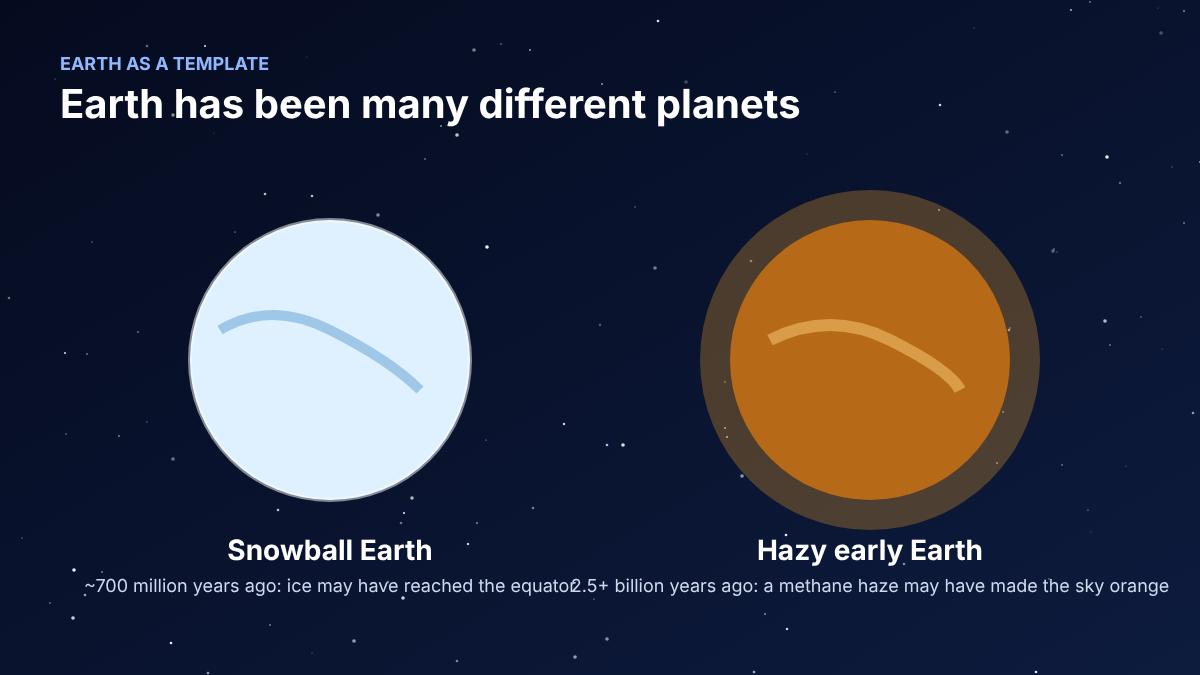
Earth's own past gives us more test cases. About 700 million years ago, ice may have reached the equator ("Snowball Earth"). More than 2.5 billion years ago, a methane haze may have turned the sky orange. Earth has been many different planets, and models that can explain them are better prepared to judge exoplanets and our own future.
Why this matters at home
Studying other worlds is not an escape from Earth's problems. It is one of the best ways to understand them.
- Venus shows where a runaway greenhouse leads. (James Hansen, who later led NASA's climate research, began his career studying the atmosphere of Venus.)
- The physics that detects CO₂ around distant stars is the same physics behind CO₂ warming on Earth.
- Climate models tested against alien worlds, under conditions far more extreme than anything on Earth, become stronger tools for projecting our own climate.
So far, Earth is the only world we know that supports life. That is a good reason to look carefully at the others, and an even better reason to take care of this one.
Tell us what you think: take our short reader survey on studying other worlds, and read our Q&A with Francis Michael Kuzler about why he is drawn to this subject.
Sources: NASA/JPL (Voyager 1 “Pale Blue Dot” image); NASA (James Webb Space Telescope detections of CO₂ on WASP-39 b and H₂O on WASP-96 b, 2022); NASA GISS ModelE and ROCKE-3D; U.K. Met Office. Figures as presented in the UCLA Planetarium talk, September 2026.